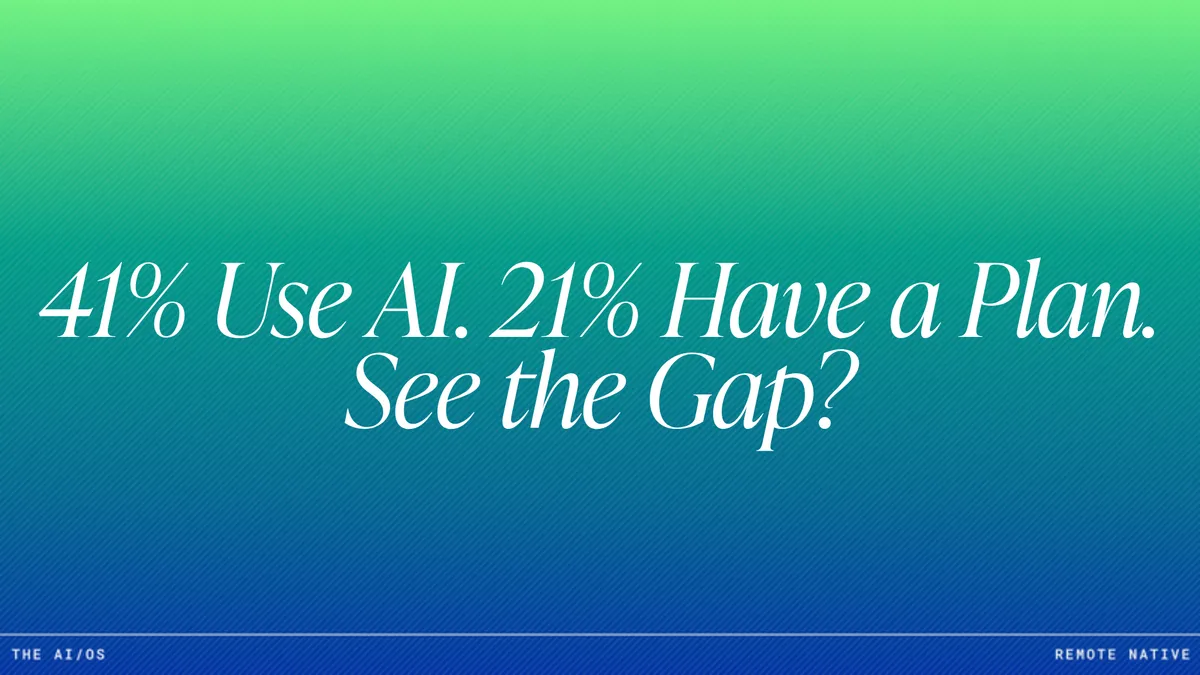
Bitkom's 2026 enterprise digitalisation study, published on 11 March 2026 and based on 604 telephone interviews with German companies of 20 or more employees, delivers a headline most German business media will celebrate: 41 percent of German companies now actively use artificial intelligence. That is up from 17 percent a year earlier: more than doubling in twelve months. Another 48 percent are planning or discussing adoption. The direction is clear, the velocity genuinely impressive.
But one figure in the study deserves more attention than the adoption rate, because it explains why adoption alone is not translating into competitive advantage: only 21 percent of German companies have a formal AI strategy. That means roughly four in five companies deploying AI are doing it without a roadmap, without defined governance, without a plan for how AI moves from individual tool usage to a change in the economics.
This is not an adoption problem. Germany has, broadly, solved the adoption problem. This is an operating-model problem, and the Bitkom data, read alongside corroborating evidence from KPMG, McKinsey, and BCG, makes the diagnosis precise.
The study in context
Bitkom surveyed 604 companies with 20 or more employees via computer-assisted telephone interviews in the opening weeks of 2026, weighted to be representative of German industry. The findings reach well beyond the adoption headline.
The momentum is real, and so is the self-assessment behind it. Seventy-seven percent of companies say AI use has improved their competitive position, and 52 percent report a measurable contribution to business success. Two-thirds intend to expand their deployment. This is not a survey of sceptics. It is a survey of a market that has decided AI matters, which makes the strategy gap all the more striking. The intent is there. The operating discipline is not.
The cost surprise is already showing up. A third of companies, 33 percent, report that AI has been more expensive than anticipated. That figure is consistent with a pattern every serious deployment encounters: organisations underestimate the non-technology costs of AI. Integration, change management, data preparation, and ongoing governance routinely dwarf the model licence and the compute bill. When a budget covers only the model and the seat licence, the overrun is not bad luck. It is arithmetic.
The workforce dimension is starker still. Nineteen percent of companies report having already cut positions as a result of AI deployment, while 53 percent name missing technical know-how as a primary barrier. Those two findings sit in uncomfortable tension. Companies are eliminating roles while simultaneously unable to staff the roles that AI-augmented operations require. That is not a labour-market quirk. It is a symptom of deploying AI without an operating model that defines which tasks get automated, which get augmented, and which demand entirely new capabilities.
And the barrier that surfaces in nearly every credible deployment study shows up here by implication too. Gartner predicts that through 2026, organisations will abandon 60 percent of AI projects that are not supported by AI-ready data. The models work. The APIs connect. The data is not ready, not aligned to a use case, not governed at the asset level, not flowing through pipelines with quality gates. That is precisely the kind of structural deficit that turns into the cost surprise and the skills barrier Bitkom records.
The strategy gap is not about documents
When the data shows only 21 percent with a formal AI strategy, the reflexive response is to commission one. A consulting engagement produces a fifty-page strategy document recommending a centre of excellence, a data platform, a governance framework, and a multi-year transformation roadmap. It lands in a SharePoint folder and changes nothing.
That is not what strategy means in the context of AI deployment. A useful AI strategy answers three operational questions: which workflows will AI transform first, who owns the outcome of each transformation, and how will we know whether it worked? Everything else (the technology selection, the vendor shortlist, the training programme) follows from those three answers. A strategy that does not resolve into a workflow running in production, measured against numbers that reach the income statement, is a document, not a strategy.
The international evidence sharpens this. KPMG's 2025 study on generative AI in the German economy, based on 653 decision-makers, found that 69 percent of respondents say they already have an AI strategy. On its face that looks far healthier than Bitkom's 21 percent, but the two figures measure different populations and different thresholds, and the gap between them is itself instructive. When the bar is "do you have a strategy," most large firms say yes. When the bar is a formal, operative strategy across a representative cross-section of the Mittelstand, the number collapses. Even among those who claim a strategy, KPMG found that only around a quarter had embedded a company-wide approach to responsible AI use. Declaring intent and building capability are not the same act.
McKinsey's State of AI puts hard numbers on the distance between the two. Across nearly 1,500 respondents, 78 percent of organisations now use AI in at least one function, yet only around 5 percent report that more than 5 percent of their EBIT is attributable to AI. McKinsey's own framing is that AI is roughly 20 percent algorithms and 80 percent organisational rewiring, and that of 25 organisational attributes tested, the redesign of workflows has the single largest effect on whether AI shows up in EBIT. Adoption is not the lever. Rewiring is. Germany's 41 percent buys a seat at that table; it does not buy the result.
Why 41 percent adoption masks a Level 1 problem
The most useful lens for interpreting the Bitkom data is the Three Levels framework. At Level 1, AI is a personal productivity tool: individuals use ChatGPT, Copilot, or a custom assistant to draft emails, summarise documents, translate specifications, research competitors. The organisation's processes and operating model remain unchanged. At Level 2, AI is integrated into specific business workflows with defined inputs, outputs, delegation rules, and measurable KPIs. At Level 3, AI operates across multiple functions with cross-functional data flows and self-improving loops.
The Bitkom study does not use this framework, but its data maps onto it with uncomfortable precision. When 41 percent say they use AI yet only 21 percent have a strategy, the implied picture is clear: most of that 41 percent are at Level 1. They have distributed tools. People are using them. No one has defined which workflows change, how roles adapt, or what success looks like at the process level.
This is the tool trap at national scale. Level 1 feels like progress because adoption metrics rise. Surveys report satisfaction. Anecdotal productivity gains circulate. The board deck shows usage climbing. But adoption is not impact. Drafting emails faster does not change the economics, does not reduce cost per transaction, and does not compound. It is exactly the "going through the motions" that McKinsey's EBIT data exposes: widespread use, scarce value.
The skills data reinforces the reading. At Level 1, the skills that matter are individual: prompt writing, tool selection, output evaluation. At Level 2, they become organisational: workflow design, delegation architecture, performance measurement, change management. The know-how gap that 53 percent of Bitkom respondents report is not, at root, about individuals who cannot write a good prompt. It is about organisations that cannot yet design, deploy, and operate AI-integrated workflows. That is a structural capability gap, not a training course.
The cost surprise is predictable
The third of companies reporting that AI costs exceed expectations are, in almost every case, meeting costs that are well documented but poorly budgeted. The technology cost (the model API, the SaaS licence, the compute) is the visible part. The invisible part is data preparation (cleaning, structuring, and validating the data that feeds the system), integration engineering (wiring AI into the ERP, the CRM, document management), change management (redefining roles, training teams, building new review cycles), and ongoing operations (monitoring, drift detection, model updates, governance). In real deployments these typically outweigh the licence, which is exactly why a model-only budget overshoots.
The Bitkom data adds a German-specific edge. The cost surprise bites harder in the Mittelstand than in large enterprises, because mid-market firms rarely carry internal AI engineering capacity. Every integration task, every data pipeline, every model adaptation reaches for an external contractor, and the economics are different when each evaluation is billed by the day rather than absorbed by an in-house team. This is not an argument against mid-market AI. It is an argument for right-sizing scope to operational capacity: start narrow, prove value in one workflow, and expand from proven economics rather than projected ones. The investment-returns gap is closed by organisations that budget for the whole operating model (technology, data, integration, people, governance) not just the part that comes with an invoice.
Position cuts without an operating model are value destruction
Nineteen percent of companies have cut positions. The figure will draw political attention, but the operational question is sharper: did those companies eliminate roles because AI genuinely automates the work, or did they cut headcount to fund AI investment without redesigning the work itself?
The distinction decides whether value is created or destroyed. Cutting roles without redesigning workflows produces no change in the economics. It produces capacity gaps that the remaining staff absorb by working harder rather than differently. If a claims team loses three people but the claims workflow is unchanged (same steps, same handoffs, same review points) the team either processes fewer claims or processes them with less oversight. Neither is an improvement; one is a hidden risk.
The companies that capture value from AI-driven workforce change redesign the workflow first: define what AI handles autonomously, what it handles under human review, and what stays human-only. Then the headcount question answers itself: fewer people in some roles, different people in new ones, more capable people in the roles that remain. Redesign first, then restructure. The reverse, restructure first and hope AI fills the gap, is how an organisation manufactures the very skills crisis that the majority of Bitkom respondents are already reporting.
The governance vacuum
No strategy means no governance. No governance means no consistency in how AI is used, no standards for data handling, no clarity on decision authority, and no mechanism for learning across deployments. Each team experiments independently, each department picks its own tools, each use case sets its own quality bar or none at all. The organisation accumulates AI activity without accumulating AI capability.
This matters more than the Bitkom data lets on, because the regulatory clock is running even if it now runs slower than the original text implied. Under the EU AI Act's Digital Omnibus, politically agreed on 7 May 2026, the high-risk obligations have been deferred: stand-alone high-risk systems under Annex III now apply from 2 December 2027, and AI embedded in regulated products under Annex I from 2 August 2028. That is breathing room, not a reprieve. Employment and HR screening, creditworthiness assessment, and access to essential services all sit in the high-risk category, and the obligations they carry (risk management, documentation, human oversight, logging) cannot be retrofitted onto a tool sprawl the week before they bite. The companies that treat the deferral as time to build governance into the operating model will clear the bar without drama. The ones that treat it as permission to keep improvising are simply moving the reckoning to 2027.
BCG's 2025 Widening AI Value Gap draws the same line from a performance angle. Only about 5 percent of companies qualify as "future-built," roughly 35 percent are scaling, and some 60 percent remain laggards with minimal revenue or cost gains and without the capabilities to scale. The leaders do not win by buying more AI; they win by building the operating model (strategy from the top, value-based prioritisation, an AI-first way of working, talent, and a fit-for-purpose data foundation) that lets each new deployment add capability rather than complexity. Governance is not overhead in that picture. It is the mechanism that lets scaling happen at all.
What the Bitkom data actually demands
Bitkom's 2026 study is the most comprehensive empirical snapshot of German AI adoption available, and it confirms that adoption is no longer the bottleneck. Forty-one percent is a meaningful number; combined with the 48 percent who plan to adopt, Germany is heading toward majority AI usage within a couple of years.
But adoption without strategy is activity without direction. The 21 percent strategy rate means four out of five deploying companies have not answered the foundational questions: which workflows change, who owns the outcome, how success is measured, and how any of it scales beyond the first use case.
The move from Level 1 to Level 2 does not require a transformation programme. It requires one specific workflow, one executive sponsor, one set of measurable outcomes, and the discipline to redesign how that workflow runs rather than layering AI onto the existing process. The readiness framework names the six dimensions that decide whether an organisation can make that transition: workflow readiness, data accessibility, integration capacity, governance clarity, organisational capability, and executive sponsorship. Bitkom does not measure these directly, but its findings light up each one: the data barrier behind Gartner's 60 percent, the know-how gap behind the 53 percent, the cost surprise behind the 33 percent, and the strategy vacuum behind the 79 percent without a formal plan.
Solving these one strategy document at a time will not work. What works is starting with a single workflow, proving the operating model in production, and building the organisational muscle the next workflow needs. The 21 percent who already have a strategy are not automatically ahead. They are ahead only if that strategy resolves into a workflow that runs in production, measured by KPIs that connect to the income statement.
A Fit Call identifies the one workflow where your current AI usage can convert into a change in the economics: before the next budget cycle funds more tool licences with nothing compounding behind them. We assess your readiness across all six operational dimensions and tell you plainly whether your AI is building capability or accumulating seats. The Bitkom data shows where Germany stands. The question is where your organisation sits inside it, and what the next 90 days should look like.
References: Bitkom, "Digitalisierung der Wirtschaft 2026," 11 March 2026 (604 CATI interviews, companies of 20+ employees); KPMG, "Generative AI in the German Economy in 2025," 2025 (653 decision-makers); Gartner, "Lack of AI-Ready Data Puts AI Projects at Risk," 26 February 2025; McKinsey & Company, "The State of AI: How Organizations Are Rewiring to Capture Value," 2025; BCG, "Are You Generating Value from AI? The Widening Gap," September 2025; Council of the EU, "AI Act simplification agreement," 7 May 2026.